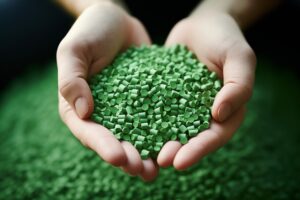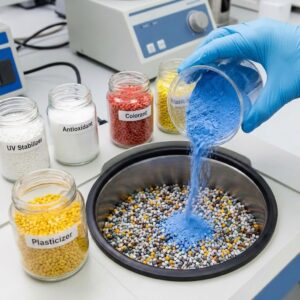
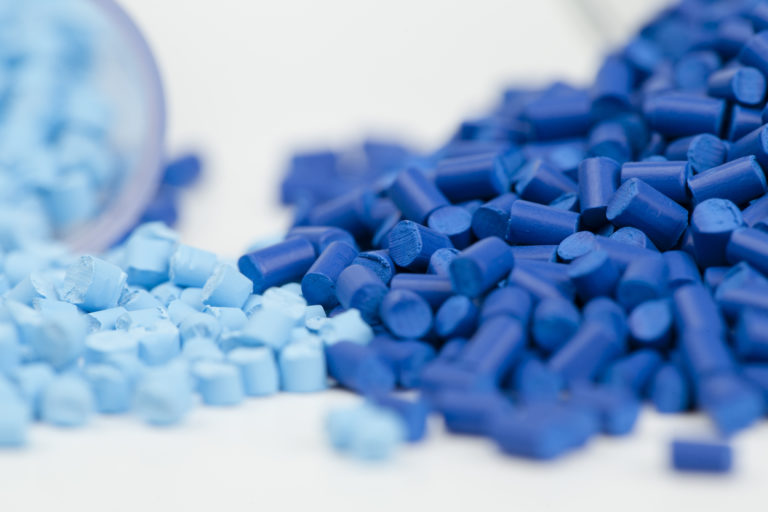
Plastics are made by polymerization. This chemical process creates long chains of repeating molecules made primarily of carbon, oxygen, and hydrogen. The physical and chemical properties of the plastic are dictated by the structure of those molecules. Process aids, UV stabilizers, and other additives are added to plastics to change their properties.
Here’s how process aids and UV stabilizers impart specific properties to plastics.
Process Aids: Uses & Benefits
Process aids are added to raw plastics to aid in the conversion of the raw plastic into finished products. Process aids (PPA) usually refer specifically to a chemical that prevents melt fracture when extruding plastic parts.
In plastic extrusion, molten plastic is pressed through a die. For example, to form a tube, melted plastic is pushed through a hollow circular die. As the molten plastic passes through the die, friction between the plastic and the edges of the die causes “melt fracture.” This abrasive action causes surface imperfections in the final product, making the surface wavy or mottled.
PPAs reduce the friction between the melted plastic and the die, analogous to a lubricant. However, the PPA is added directly to the melted plastic rather than being coated on the surface of the extrusion die. PPAs decrease the viscosity and “stickiness” of the melted plastic, improving its melt flow. This not only reduces melt fracture but also reduces melt buildup on the die, which can cause die wear and production delays while dies are cleaned.
UV Stabilizers: Uses & Benefits
Organic molecules, whether they make up plastics or your skin, are prone to damage by ultraviolet (UV) rays. When UV rays strike organic molecules, two forms of damage can result.
- Oxygen molecules absorb the UV rays and reach an excited state. The excited oxygen atom creates a free radical that is highly chemically reactive.
- Bonds between oxygen, hydrogen, and carbon atoms break, resulting in discontinuities in the polymer chains.
The damage to the molecules of the plastic causes it to become discolored and brittle. While these changes may have little consequence for some plastic goods, protective or load-bearing goods can become significantly weakened through this process. For example, a rope made from plastic will degrade when exposed to the UV radiation in sunlight.
UV stabilizers are added to most plastics that are exposed to the environment. UV stabilizers can act in two different ways inside plastics.
One group of UV stabilizers is referred to as radical scavengers. These UV stabilizers, such as hindered amine light stabilizers, convert free radicals into stable molecules.
The other group of UV stabilizers absorbs UV radiation. This mechanism is analogous to sunscreen applied to the skin. The molecules in the UV stabilizers absorb UV radiation, sacrificing themselves to protect the plastic.
Hazards of Process Aids and UV Stabilizers
Process aids and UV stabilizers are generally safe to add to plastics. Rather than coatings, they are added directly to the raw plastic before extrusion. As such, they are locked into the plastic’s wall and are unlikely to bloom to the surface.
That said, “generally safe” deserves some unpacking. The safety profile of these additives depends significantly on context — specifically, how the plastic is being processed, what it will be used for, and who or what it might come into contact with during its life cycle.
During manufacturing, the primary concerns are in the processing environment itself. When plastics are melted at high temperatures, some additives can off-gas volatile compounds. Workers operating extrusion or injection molding equipment in poorly ventilated facilities may be exposed to those fumes over time. This is less a property of the additives being inherently toxic and more a function of thermal conditions and workplace safety practices. Proper ventilation, equipment maintenance, and adherence to handling guidelines are the relevant controls here.
For finished products, the picture is generally more favorable. Because process aids and UV stabilizers are compounded directly into the polymer matrix rather than applied as surface treatments, they are chemically bound within the material’s structure. This significantly limits migration — the tendency of an additive to move through the plastic and reach the surface over time. Blooming, where additives do migrate and form a visible residue or film on the surface, is more commonly associated with incompatible or overloaded additive systems. A well-formulated compound using appropriate additive levels for the base resin largely avoids this.
Process aids and UV stabilizers substantially improve the physical and chemical properties of plastic goods. Contact Phoenix Plastics for more information about these and other high-quality plastic additives.