

Desiccants play a crucial role in ensuring the quality and durability of plastic materials. Plastic is a mainstay in our society, used in an infinite number of products and applications. Plastics are formulated for their intended use. However, plastics may contain water formed in high-temperature molding, and the water bubbles can cause holes and other defects, impacting the mechanical properties, quality, and appearance of the plastic products. The way to avoid these issues is with the use of desiccants. Desiccants work to remove water during processing, effectively eliminating the presence of air bubbles and other defects.
Desiccants Offered by Phoenix Plastics
Because of our long history of manufacturing plastics at Phoenix Plastics, we know that products are not one-size-fits-all. That is why we offer three different desiccant products:
Cel-Span Process Aid 740®. This product is for use in nylon and nylon-type alloys. This product  contains a water-seek additive that chemically combines and eliminates lensing and porosity in nylon-type systems and compounds. It is particularly helpful in the use of nylon resins that are used in extrusion, injection blow molding, blow molding, and film.
This product features great benefits: It is easy to use, no process changes are required, it can be used at the normal resin processing temperature and RPM speed, it is safe and non-hazardous, and it offers a one-year shelf life.
Applications: Injection and Blow Molding, Pipe/Profile Sheet, Compounding, Film
Temperature Range: 350°F – 650°F
Melt Flow: 6.0 gm / 10 min. with 2160 wt at 190 °C
Blend Density: 2.3 gms/cc
Types of Resins: Nylon and Nylon-type alloys
Cel-Span Drying Agent and Process Aid 746. This product is specifically for use in TPU resins. It contains a powerful water-seeking additive that chemically combines and eliminates lensing and porosity in polyurethane resin systems and alloys. Cel-Span 746® is compatible with all tailored or all TPU resins, copolymers, and TPU alloys, as well as ester-based resins.
This product features great benefits: It is easy to use, no process changes are required, it can be used at the normal resin processing temperature and RPM speed, it is safe and non-hazardous, and it offers a one-year shelf life.
Applications: Injection & Blow Molding – Pipe/Profile Sheet – Compounding – Film
Temperature Range: 375°F – 450°F
Blend Density: 2.7 g/cc
Types of Resins: Polyurethane, Ether, and Ester
base plus Copolymers and alloys
Recommended Levels: 0.5 to 1.5%, depending on the moisture level in the host resin.
Cel-Span Drying Agent and Process Aid 748®. This product is used specifically for 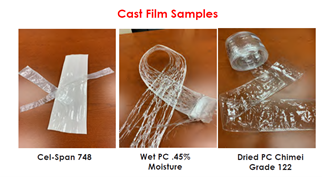 polycarbonate applications. It has a powerful water-seeking additive that chemically combines and eliminates lensing and porosity in polycarbonate resin systems and alloys. It is compatible and tailored for use with all polycarbonate resins and PC/ABS alloys.
This product features great benefits, including ease of use, no process changes are required, it can be used at the normal resin processing temperature and RPM speed, it is safe and non-hazardous, and it offers a one-year shelf life.
Applications: Injection & Blow Molding – Pipe/Profile Sheet – Compounding – Film
Temperature Range: 500°F – 575°F
Blend Density: 2.2 g/cc
Types of Resins: Polycarbonate and PC/ABS alloys
Recommended Levels: 0.5 to 2.5%, depending on the moisture level in the host resin.
Need Desiccants? Phoenix Plastics Can Help!
As you can see, Phoenix Plastics is very familiar with desiccants, and we would be pleased to help you choose the right product for your specific compound. Simply contact us today, and we will discuss your unique needs! We look forward to working with you soon!